
‘Lift Every Voice and Sing’: The Story Behind the Black National Anthem
Before it was a song, it was a poem. Before it echoed through churches, schools, stadiums and presidential inaugurations, it


Before it was a song, it was a poem. Before it echoed through churches, schools, stadiums and presidential inaugurations, it was a quiet act of resistance written in the heart of the segregated South.
The year was 1900. Reconstruction had crumbled. Jim Crow laws were sweeping across the South, stripping Black Americans of hard-won rights. Voting rights were being rolled back. Lynchings were rampant. The hope of freedom that had bloomed after the Civil War was quickly withering.
In Jacksonville, Florida, James Weldon Johnson — a principal at a segregated school — was preparing a program for his students to commemorate Abraham Lincoln’s birthday. Johnson, a man of many talents—a writer, lawyer, educator, and activist—initially set out to write something about the 16th president. But the weight of the times demanded more than a celebration of the past. It called for a reckoning with the present.
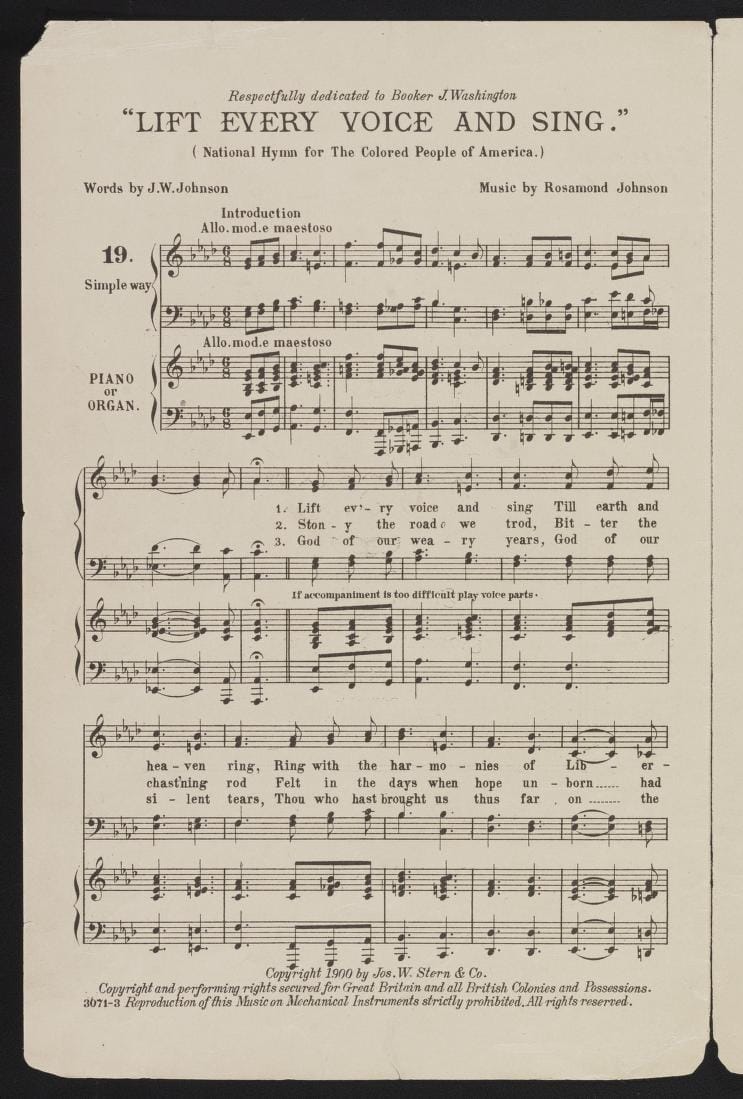
So, instead of a tribute to Lincoln, Johnson wrote a poem: a lyrical expression of pain, perseverance, faith, and hope. A declaration of resilience. He called it "Lift Every Voice and Sing."
A Brother’s Tune, A People's Anthem
Johnson’s younger brother, J. Rosamond Johnson, a composer and musician, saw the potential for something greater. He set the words to music, transforming the poem into a hymn-like anthem. Its first performance came on February 12, 1900, when 500 Black schoolchildren stood to sing it at a Lincoln birthday celebration in Jacksonville.
But the song didn’t stay in Jacksonville. Word — and melody — spread. It traveled from school to church, from town to town, becoming a unifying hymn for Black communities across the country.
In 1919, the NAACP adopted "Lift Every Voice and Sing" as its official song, recognizing its power to inspire and unify. The following year, James Weldon Johnson was appointed executive secretary of the organization, cementing the connection between the song and the struggle for civil rights.
Lyrics Rooted in Reality
The words of the song are steeped in the lived reality of Black Americans at the turn of the century. Phrases like “stony the road we trod,” “bitter the chastening rod,” and “hope unborn had died” weren’t poetic abstractions. They were everyday truths.
“Lift Every Voice and Sing” wasn’t written to be a national anthem—it became one because of what it meant to the people. It wasn’t born of legislation or political compromise; it rose from schoolyards and sanctuaries, from rallies and resilience. It was—and remains—a grassroots declaration of dignity.
A Living Legacy
More than a century later, “Lift Every Voice and Sing” continues to resonate. It is sung at Black History Month events, graduation ceremonies, protests, inaugurations, and family reunions. In recent years, it has gained renewed visibility on national stages, stirring conversations about race, patriotism, and remembrance.
It stands not only as a piece of history but also as a living response to the continued struggle for justice. It is a reminder that even when systems fail, voices rise.
So the next time you hear “Lift Every Voice and Sing,” remember: you’re not just hearing a song.
You’re hearing survival.
You’re hearing resistance.
You’re hearing faith set to music.
You're hearing history—one verse at a time.