
Rebuilding What Was Never Meant to Be Broken
Somewhere along the journey, cooperation was quietly replaced with conflict. Not by accident—but by design. What once stood as

We sat with Community advocate Denise Cambridge as a part of our Sunday Conversation series highlighting her work to increase civic awareness and voter participation ahead of the May 19 election. ere is our conversation.
Courier: What inspired you to create the 2026 Civic Engagement Handbook at this moment in our community?
Cambridge: My inspiration really started in 2022 when I had the opportunity to work on a statewide campaign. It was my first time going beyond just telling people to “go vote” and actually seeing what it takes to build a campaign—from a candidate declaring, to qualifying, to connecting with voters, all the way to winning a primary in a four-way race. That same year, on February 22, 2022—“Twosday”—I visited the State Capitol for the first time. That moment really sparked something in me. It made me realize that the decisions being made in those rooms directly impact our everyday lives, but many people don’t have access to clear, understandable information about how it all works. From there, I became more intentional about learning and getting involved. In 2023, I began training in organizing and movement work and started studying the legacy of women in the civil rights and voting rights movements. One moment that stood out to me was receiving a copy of Constance Baker Motley’s autobiography with a handwritten note on official U.S. District Court stationery inside. For me, that felt like confirmation that I was walking in purpose. Then came a local school board special election that was decided by just two votes. That moment stayed with me because it gave me a real example to show people that one vote truly does matter.In 2024, my oldest daughter became a first-time voter. I realized I had been preparing the community, but I hadn’t fully prepared her. When she told me she wanted her vote to reflect her voice—not mine—that moment gave me chills. It reminded me how important it is to educate and empower first-time voters. Then in 2025, during the Georgia Public Service Commission special election, I remember telling people it was the last day of early voting, and the response I kept hearing was, “What are we voting for?” That was the moment everything clicked.I realized we don’t just have a voter turnout issue—we have an information access issue. So I pulled together everything I had been gathering since 2022, opened a blank document, said a prayer, and got to work. This handbook is the result of that journey—created to make sure people don’t just show up to vote, but show up informed.
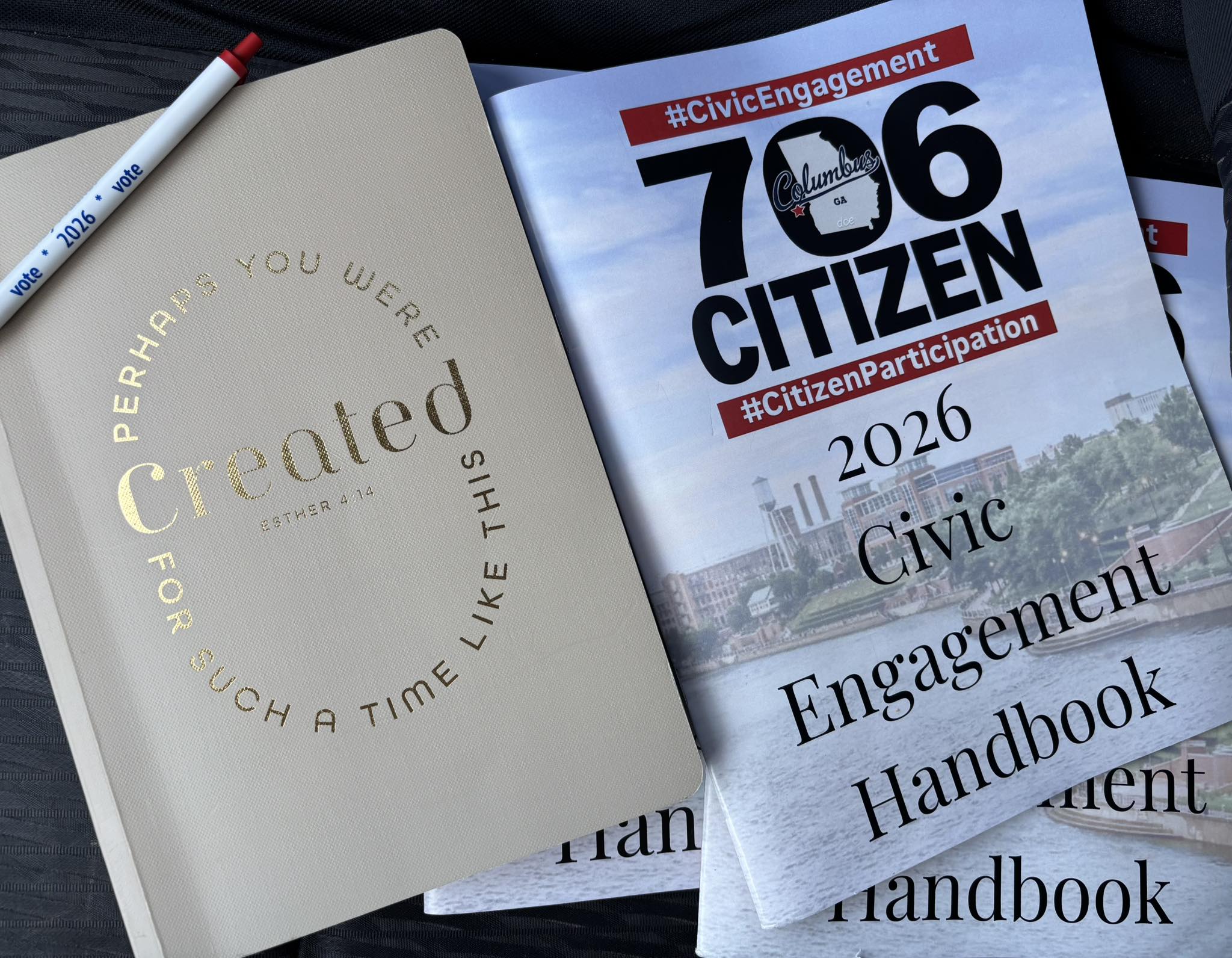
Courier: For those who may not be familiar, what exactly is included in this handbook and who is it designed for?
Cambridge: This handbook is designed for the citizens of Columbus, Georgia. It includes information to help people know exactly who represents them—from our mayor, city council, and school board to state and federal representatives. It also includes meeting schedules for city council and school board, so citizens can stay engaged beyond elections. The handbook outlines what’s on the ballot for 2026 at every level, with a specific emphasis on local races like mayor, city council, and school board. The goal is to make sure voters have all of this information in one place.
Courier: Why is a resource like this especially important heading into the May and November 2026 elections?
Cambridge: It ensures that voters are not guessing when they get to the polls.They are prepared. They are informed. They know who is on the ballot, and they know who they want to see represent them. This resource helps voters move with intention instead of uncertainty.
Courier: What gaps did you see in voter awareness or participation that this handbook is designed to fill?
Cambridge: A lot of times during election season, you see campaign signs everywhere—but you may not actually know who that person is. This handbook helps connect the dots. It ties together name recognition with real information—who the candidates are, what they stand for, and what issues they want to address in their communities.
Courier: How does this guide help voters move from confusion to confidence when they step into the voting booth?
Cambridge: It allows voters to walk into the voting booth already knowing who they are choosing to represent them. It removes uncertainty and replaces it with clarity. That’s how you move from confusion to confidence.
Courier: In your view, what is the biggest misconception voters have about local elections?
Cambridge: That local elections don’t carry the same weight as federal elections. In reality, local elections often have a more direct impact on your everyday life. While federal decisions matter, local decisions are closer to the voter—and voters can often have an even greater impact at that level.
Courier: Walk us through the key sections—what can a voter expect to find from beginning to end?
Cambridge: The handbook walks voters through representation at every level—local, state, and federal. It starts with local leadership: mayor, city council, and school board. Then it expands to state leadership, including state senators, House representatives, and statewide offices like governor, lieutenant governor, secretary of state, and others that play key roles in policymaking. It also includes federal representation—U.S. senators and members of Congress. The goal is to give voters a full picture of who represents them and how government is structured across all levels.
Courier: Does the handbook include candidate profiles, issue summaries, or voting instructions?
Cambridge: The handbook includes candidate information, specifically what each candidate has identified as their campaign priorities and the issues they want to address. It does not tell voters what issues to prioritize—that decision is left to the voter. While it doesn’t give step-by-step voting instructions, it does direct users to the Georgia Secretary of State’s My Voter Page, including a QR code, so they can check their registration, voter information, and polling details. There’s also an interactive section at the beginning where users can fill in their own information and identify who represents them.
Courier: How did you gather and verify the information to ensure it’s accurate and unbiased?
Cambridge: A lot of this started with attending city council and school board meetings and taking detailed notes. I began sharing recaps, and people started asking follow-up questions—that helped guide what information needed to be included. From there, I gathered information directly from official sources—city websites, school district sites, the Georgia General Assembly, and federal government websites. Those sources are also listed throughout the handbook so people can verify and explore further on their own.
Courier: Why should voters pay more attention to local races like city council, mayor, and school board?
Cambridge: Local government is closest to the people. If you think of it like a circle, the voter is at the center. The closest layer is local government—mayor, city council, school board. Then comes state, then federal.In a community like Columbus, we’re in a unique position where our elected officials are accessible—we may see them in our neighborhoods, churches, or schools. That makes local engagement even more powerful.
Courier: How do local decisions directly impact everyday life in communities like Columbus?
Cambridge: Local decisions impact transportation, housing, education, and how resources are distributed in the community. They affect things like school operations, infrastructure, and how we address challenges like housing and economic development. These decisions shape our everyday quality of life.
Courier: What would you say to someone who believes their vote doesn’t make a difference?
Cambridge: I would point to real examples—like elections decided by just a few votes.One person. One vote. That can determine leadership and the direction of a community. If someone believes their vote doesn’t matter, I would simply say—cast it anyway. See the impact for yourself.
Courier: Does the handbook explain how to register to vote, vote early, or request absentee ballots?
Cambridge: The handbook directs users to the Georgia Secretary of State’s website, including a QR code to access the My Voter Page. It also includes early voting dates, locations, and times in a dedicated section so voters can plan ahead.
Courier: How are you ensuring that this information reaches first-time voters, seniors, and underserved communities?
Cambridge: We’re using a mix of digital and in-person outreach. The digital version makes it easy to share widely, especially for younger voters. For seniors, we’re working to provide printed copies. And for underserved communities, we’re showing up—attending events, meeting people where they are, and putting the information directly in their hands. We’re also sharing information consistently through The 706 Citizen platforms, especially on social media.
Courier: Are there plans to distribute the handbook digitally, in print, or both?
Cambridge: Both. The digital version is the easiest way to make sure the information is widely shared and accessible. People can quickly send the link or QR code in a text message—if you’re having a conversation with someone, you can immediately say, “Here’s a resource to help you stay informed and engaged.” We do have printed copies in circulation, although they are limited. If someone would like a copy, we can work to get that into their hands. We’re also attending community events and sharing the handbook directly with citizens to make sure the information reaches people where they are.
Courier: How does your handbook encourage voters to look beyond campaign slogans and truly evaluate candidates?
Cambridge: The handbook points directly to each candidate’s platforms, priorities, and the concerns they’ve identified for the community. That gives voters something real to connect to. For example, if a voter is concerned about affordable housing and sees a candidate addressing that issue, they can take a closer look at that candidate. It also works the other way—if a voter doesn’t see their concerns reflected, it gives them a starting point to reach out, ask questions, and engage directly with candidates about what matters most to them.
Courier: What questions should voters be asking candidates before casting their vote?
Cambridge: Voters should start by asking themselves: Am I pleased with the direction Columbus is going? Then think about the future—what do I want Columbus to look like in 5, 10, or even 20 years? What kind of growth, infrastructure, and opportunities do I want to see? From there, the question becomes: Do these candidates align with that vision? That helps voters make decisions based on where they want the community to go—not just where it is today.
Courier: How important is it for voters to understand policy—not just personality?
Cambridge: It’s very important. A candidate may be charismatic and relatable, but voters also need to ask: Can they understand, develop, and implement policy? Can they execute decisions that not only make us feel good, but actually move the community forward? Policy is what shapes outcomes. Personality may draw attention, but policy is what impacts lives.
Courier: What role do young voters play in shaping the future of this election cycle?
Cambridge: Young voters—especially those ages 18 to 25—are often overlooked, but they are incredibly aware and engaged. They are already having conversations about issues like education, the environment, and social concerns. Many are already involved in advocacy and organizing within their own circles. They’re not just future leaders—they are leaders right now. And their voices deserve to be heard and taken seriously in this election cycle.
Courier: How can this handbook be used as a teaching tool in schools or youth organizations?
Cambridge: The handbook is designed to be simple, clear, and accessible. It’s a condensed resource that breaks down complex information into something easy to understand. It also points back to official sources, so if someone wants to go deeper, they can. That makes it a strong foundation for discussions in classrooms, youth groups, and community programs focused on civic education.
Courier: In your opinion, what does true civic engagement look like beyond just voting?
Cambridge: It looks like staying informed, doing your own research, and participating in the process. It means attending meetings—or watching them online—asking questions, and reaching out to your elected officials to share your concerns. Civic engagement is about being active and involved year-round, not just during election season.
Courier: How do we shift from a culture of complaints to a culture of participation?
Cambridge: It starts with knowledge and understanding. When people know how things work, they’re better equipped to take action. We can take that frustration and redirect it into something productive—into engagement, into participation, into being part of the solution.
Courier: What responsibility do community leaders, media, and churches have in educating voters?
Cambridge: They carry a significant responsibility. These are trusted spaces where people already go for information and guidance. With that influence comes the responsibility to share accurate, reliable information—especially in a time when misinformation spreads quickly. Being a trusted messenger means making sure the community has what it needs to stay informed.
Courier: What challenges did you face in creating this handbook?
Cambridge: One of the biggest challenges was narrowing down the information. There’s so much I wanted to include, but I had to decide what was most important and how to present it in a way that was clear and easy to understand. I also gained a new appreciation for authors, illustrators, and graphic designers—because bringing everything together in a way that flows well is no small task.
Courier: Have you encountered any resistance or skepticism about this effort?
Cambridge: No—honestly, I’ve received a lot of encouragement and support. People have expressed appreciation for having a resource like this, and that has been very motivating.
Courier: How do you respond to misinformation that often spreads during election season?
Cambridge: I see it as an opportunity to educate. When misinformation shows up, we can turn it into a teachable moment—share accurate information, provide credible sources, and help people better understand the facts.
Courier: Where can people access the Civic Engagement Handbook?
Cambridge: The handbook is available through The 706 Citizen Facebook page. There’s a link and QR code posted there, along with a Linktree that includes additional resources. We’re also working toward creating a more permanent home for the handbook.
Courier: What is the one thing you want every voter to do after reading it?
Cambridge: Share it. Share it with a neighbor, a friend, a family member, a coworker—especially first-time voters and seasoned voters alike. And after you’ve shared it—go vote.
Courier: If you had one message to the community about the upcoming elections, what would it be?
Cambridge: My message is the same one I’ve carried for the last four to five years: local elections matter. The people you elect to represent you on the school board, on city council, and as mayor are just as important as those you elect at the state and federal levels. These are the leaders making decisions that impact your everyday life—so your participation in these elections matters.
Courier: Denise, finish this sentence for us: “An informed voter is…”
Cambridge: An informed voter is an empowered citizen. A citizen who is actively participating in the process of local government. A citizen who is showing up—not just talking about issues on social media or in conversations with friends and family—but showing up in real spaces like city hall and school board meetings.An informed voter is not on the sidelines. They are engaged, aware, and involved in shaping their community.
Courier: And finally, what does “your vote matters” truly mean—not just as a slogan, but as a responsibility?
Cambridge: “Your vote matters” means it is an honor, a privilege, and a right. It is a right that people fought for—sacrificed for—so that we would have a voice in shaping our communities and our future. And with that right comes responsibility. It means showing up. It means being informed. And it means using your voice—because your vote is how you help decide the direction of your community.